
Why Website Speed Matters for SEO, User Experience, and User Interface
Learn why website speed matters for SEO, UX, and UI. Discover its impact on rankings, user engagement, conversions, Core Web Vitals, and mobile performance for Brand Mindz
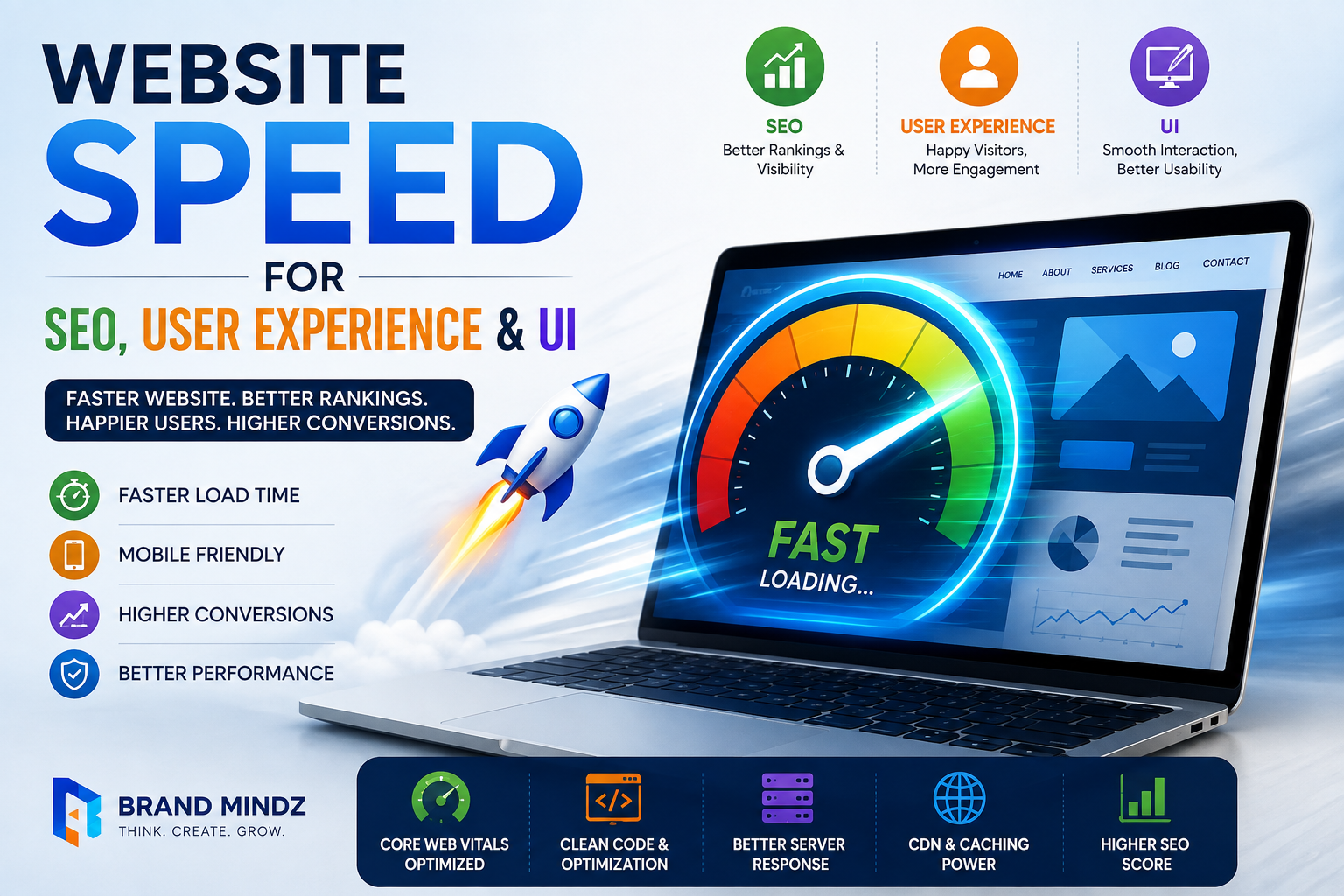
What is website speed? Website speed is about how fast a website loads and starts working when someone visits it. It’s about how fast a web page shows you its information, how fast it reacts to things you do, and how fast you can move around without any hitches. Regarding website speed, it is the time a person has to wait until he can properly see and use a web page.
How Website Speed Works The browser sends the query to the server. The browser sends the query to the server. The server checks the request. The server checks the request. Returns requested data. Returns requested data. This can be things like HTML files or other types like CSS and JavaScript, as well as media like images and fonts. Then the browser figures out what this data is. Finally, the user sees a web page on his or her screen. Finally, the user sees a web page on his or her screen. They can work on the premises. They can work on the premises.
Website Speed vs. Page Load Time Website speed indicates how quickly a website appears and functions. Page load time tells us how long it takes to open a webpage and everything it contains. Page performance is a term describing how quickly a page loads, how good the work of the page is, and what a user feels while using the website.
Why Website Speed Matters Improves User Experience People like it when they can get to a website fast. When a website loads quickly, it is easier for visitors to look around. It feels more comfortable for the visitors to use the website. Visitors like websites because they can find what they need without waiting a long time. The website is more fun to use when it is fast. Visitors will like the website more if it loads quickly.
Reduces User Abandonment When a webpage is really slow to load, people who visit the webpage may get tired of waiting. Leave the webpage before they even see what is on the webpage or do what they wanted to do on the webpage.
Supports SEO Google looks at how a webpage works and how good the page experience is when it checks out webpages. If a webpage performs well, it can make searching on Google an experience for people who use Google. Google thinks that good performance is important for a good page experience. Increases Conversions A faster website is really helpful for people who visit it. They can do things like submit a form or buy a product. They can also book a service. Get in touch with a business. This is because a faster website makes it easier for visitors to do things like submitting a form, purchasing a product, booking a service, or contacting a business.
Improves Mobile Experience Mobile users often have less reliable internet connections. Making sure the website loads quickly is very important for sites. Mobile users often have less reliable internet connections. Making sure the website loads quickly is very important for sites.
Website Speed and SEO Website speed and search engine optimization are really connected because search engines want to give users websites that're fast and easy to use. Search engine optimization performance is also supported by a website that is working well. This is because users like websites that are fast, useful and easy to use, so website speed and search engine optimization are important, for a webpage.
Impact of Page Speed on Search Engine Rankings Page speed is really important for the page experience. If a website is slow, it can be pretty bad for users. They will not have a time on the website. On the other hand, a fast website that works well is great for visitors. They can easily look at the content. Interact with it. So making the website faster can help with search engine optimization performance. Page speed is something that can make a difference. Improving page speed can support page experience and search engine optimization performance.
Core Web Vitals and Website Performance Core Web Vitals are metrics from Google that help us see how well a webpage works for people who visit it. Core Web Vitals measure things that are really important, to the people who use a webpage.
LCP (Largest Contentful Paint) This thing measures how quickly you can see the content of a page. The main content of a page should be visible in 2.5 seconds or less for a large content paint, or a good LCP, for short; to be honest, a good LCP is 2.5 seconds or less.
INP (Interaction to Next Paint) This thing measures how fast a webpage reacts when you do something on it, like click on something or tap on it. A good input delay is when the webpage responds in 200 milliseconds or less. Input Delay is really important because it shows how fast a webpage reacts to what you do on it.
CLS (Cumulative Layout Shift) The page layout can sometimes jump around when it is loading. This is not what we want. We want the page layout to stay still. A good page layout score is when the layout does not move much, like 0.1 or less. This means the cumulative layout shift, or CLS, is small. A small CLS is what we are looking for.
Faster Websites Help Search Engines Crawl and Understand Pages Efficiently A faster website is really helpful for search engines like Google. They can look at the website. Get the information they need from the webpages much faster. When the pages load quickly and the pictures and other things are working well, search engines can look at the website content. Understand it better. This makes it easier for search engines to find the website and show it to people who are searching for things. A faster website is good for search engine crawlers because they can access and process webpages efficiently.
Improves crawl efficiency Search engine bots are able to get to pages and things on the internet easily. This is because search engine bots can look at lots of pages and resources. Search engine bots do this so they can find what they need quickly. This helps search engine bots do their job better.
Supports better page understanding Having pages that're easy to understand and work well helps search engines like Google process the content on these pages. This means search engines can look at the content on the pages and know what it is about. Search engines like this because it makes their job easier. Structured pages are very important for search engines to process the content.
Improves overall website performance When we have pages, it is really good for the people who use them and for search engines like Google. Faster pages make everything easier for users and search engines.
Supports SEO A website's performance is really important for giving people an experience when they look at a page. The performance of a website is one part of providing a good page experience. When we talk about a good page experience, the performance of a website plays a role.
Mobile Page Speed and SEO Mobile page speed is about how fast a web page loads and starts working on phones and other mobile devices. A lot of people visit websites using their phones, so making sure mobile performance is good is a part of SEO and making sure people have a good experience.
Better mobile experience: A better mobile experience is really important. Users can get to the content they want quickly. Lower user frustration: This means people do not get frustrated when they are using their mobile. Faster pages mean you do not have to wait around for a long time. Supports search visibility: A good mobile experience also helps with search visibility. When a website is easy to use and loads quickly, it can support search engine optimization performance.
Improves engagement: People are more likely to stay on a website and interact with it when the pages load quickly. A mobile experience that is fast improves how people engage with a website.
Website Speed and User Interface (UI) Website speed and user interface are really important together. You see, a website that looks nice is not good enough if people have to wait a long time for things like pages, buttons, menus, images, and forms to work. A website that is fast and looks good helps people use it easily and quickly. This is because a good user interface makes it simple for visitors to interact with the website. The user interface is what people see and use when they are on a website. So it has to be good. A fast user interface is very important for a website.
How Fast-Loading Pages Improve Interaction with Website Elements Fast-loading pages are really important because they let users see things and use the website quickly. When things show up quickly, people can easily move around the website, read what they need to, and do what they want to do. For example, when someone clicks on "Contact Us," the website should open the contact section or page fast. If it takes a long time, the website feels slow, and people might not want to use it anymore. Fast-loading pages, like these, make the website feel better to use
Faster Buttons, Menus, Images, and Forms Buttons: Buttons should work fast when people press them. Menus: Menus should come up easily without any delays. Images: Images should be set up to load fast so the page doesn't get stuck. Forms: Forms, like contact, registration, and enquiry, should work well. Not take long. Search features: Search boxes and filters should give answers quickly without making anyone wait.
Importance of Responsive and Performance-Focused Design A good website should work well on all devices. It should look good on computers, small tablets, and little smartphones. This is what we call a responsive website. A responsive website is one that works properly on all these devices. Website performance is also very important. This means the website should load quickly and respond fast on all devices. When we talk about a website, we want a website that's responsive and loads fast. A responsive website and good performance make a website that people like to use.
Balancing Attractive Design with Website Performance A website needs to look good and be interesting. Too many fancy things can make it slow. Big pictures, moving videos, special fonts, and extra effects can make the page bigger. Take longer to load. The goal is to make the website look nice and work well at the same time.
How Slow Websites Affect Businesses A slow website can have an effect on how people feel when they use it and how well the business does. When people have to wait for pages to come up, they might leave the site before doing anything.
When a webpage takes a long time to load, the bounce rates are higher. This means that visitors may leave quickly. Slow loading can cause users to choose a competitor's website over the website, so there is a loss of potential customers. Delays can reduce actions such as purchases, inquiries, and registrations. Form submissions on the website result in lower conversions. A slow or unresponsive website can make a business appear unprofessional or unreliable, which is a poor brand perception. The poor page experience and performance of a website can negatively affect search engine optimization, which is SEO, and make it harder for webpages to compete in search results, resulting in reduced search visibility.
How to Improve Website Speed Optimize images To make your website work better, you need to do a few things. Optimizing images is very important. This means you have to compress images and pick the formats and sizes so the file size is small.
Minify CSS, JavaScript, and HTML You also have to minify CSS, JavaScript, and HTML. This means you make the file size smaller by taking out spaces, characters, and code that you do not need.
Use browser caching Use browser caching. This means you store things that people use a lot on your website in their browser so they do not have to download them.
Improve hosting/server performance. Improve server response time. You have to use hosting and make sure your hosting and server are working well.
Use a Content Delivery Network (CDN) You should also use a Content Delivery Network. This is like a helper that gives people the things they need from your website from a server that is close to them, so it does not take as long to load.
Reduce unnecessary plugins and scripts. Reduce plugins and scripts. Take out any plugins, tracking codes, and scripts from other people that you are not using because they can make your pages load slowly.
Optimize mobile performance Optimize performance. Make sure your pages, images, and everything else are working well on smartphones. Optimizing images and optimizing mobile performance are very important because a lot of people look at websites on their phones.
Tools to Check Website Speed Google PageSpeed Insights This tool checks how well a webpage works on phones and computers. It also gives ideas on how to make the webpage load faster and how to make it better for people to use. Webpage performance is very important for desktop users, so this tool helps to improve webpage performance on both mobile and desktop.
GTmetrix This tool gives us reports on how things are working. It shows us things like how long it takes to load and how well it is doing. We also get tips on how to improve the performance of our website or application. It tells us about things like loading behavior and performance metrics. Then it gives us recommendations for optimization.
Google Search Console Helps website owners keep track of how their site's performing in search results. It also has Core Web Vitals reports. These reports give information about the experience people have when they visit a web page.
Lighthouse The Lighthouse tool is really useful for checking how well webpages work. It looks at things like performance and accessibility. The Lighthouse tool also checks for search engine optimization, which's important for websites. You can find the Lighthouse tool in Chrome DevTools and some other tools that Google makes for developers. The Lighthouse tool is a help when you want to make sure your webpage is good quality.
FAQ 1. What is considered a good website loading speed? A good website should load its main content quickly, ideally within a few seconds. For SEO and user experience, businesses should also aim for good Core Web Vitals, including an LCP of 2.5 seconds or less. 2. Does website speed affect SEO rankings? Yes. Website speed contributes to page experience and can influence how well a page performs in search. However, speed is only one part of SEO. Content quality, relevance, backlinks, technical SEO, and other factors also matter. 3. Why is my website slow even though it has good hosting? Good hosting does not automatically guarantee a fast website. Large images, unnecessary plugins, poorly optimized JavaScript, third-party scripts, database issues, and inefficient website code can also slow down a website. 4. Can too many images make a website slow? Yes. Large, uncompressed images can increase page size and take longer to download. Compressing images, using modern formats such as WebP or AVIF, and serving appropriately sized images can improve loading performance. 5. Does website speed matter more on mobile devices? Mobile speed is especially important because users may have slower or less reliable connections and less powerful devices. A website that works well on mobile can provide a better experience and support overall SEO performance. Final Thing A website needs to be fast to be successful these days. This is because the speed of a website affects how people find it, how they use it, and what they think of it. When a website loads quickly, people can get to the content they want right away. They can also click on buttons and menus easily and look at pictures and fill out forms without any problems. This helps them stay on the website and keep looking. A fast website also helps with search engines. Makes the whole experience better for visitors.
On the other hand, if a website is slow, people will probably leave right away. This means businesses will lose customers, not make many sales, and people will not think very highly of them. They will also have a hard time finding the website when they search for it. To make a website faster, businesses can do a few things. They can make their pictures smaller, get rid of code that they do not need, make their servers work better, use special services to help with speed, and make sure their website works well on phones.
Overall, businesses should try to make websites that are fast and work well. They should also make sure they look nice and are easy to use. If they can do all these things, people will like using their website. They will be more likely to come back. This will also help businesses do better in the long run and get more people to find them when they search online. Website speed is very important for this. Businesses need to think about website speed when they make their website.